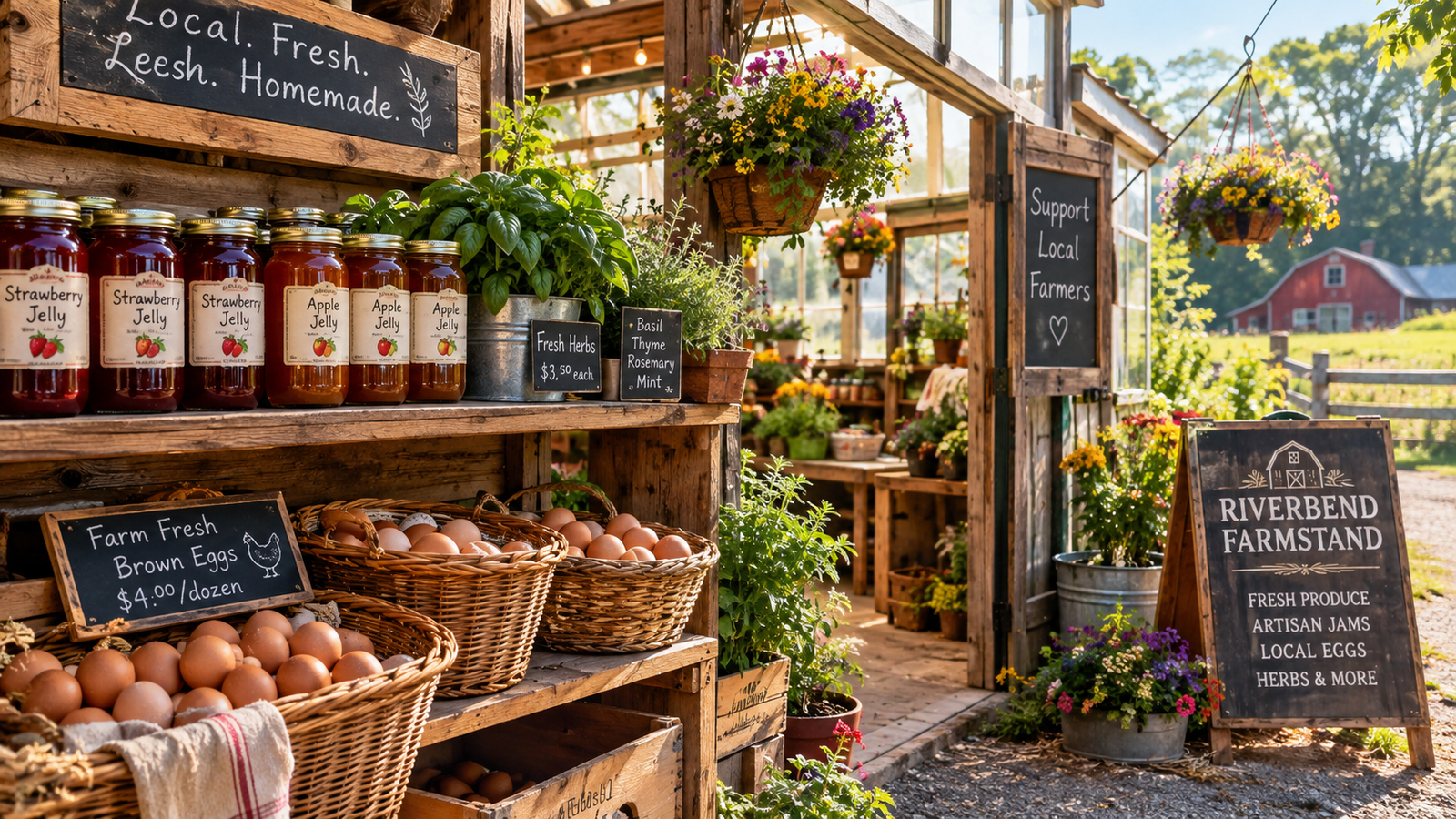
What happens when your five children grow up, move out, and leave you with an abundant backyard harvest you can no longer consume?
For Illinois resident Shannon Jacobs, an empty nest did not trigger quiet retirement—it sparked the launch of Roots Market, turning backyard fruit patches and artisanal canning into a thriving full-time agribusiness.
The 3.5-Acre Economic Model: Small-Scale Agronomy
3.5-Acre Homestead ➔ Empty Nest Excess Harvest ➔ Cottage Food Certification ➔ Multi-Revenue Farmstand
| Operational Pillar | Infrastructure & Assets | Revenue Stream | Economic Significance |
| Orchard & Vineyard | Heritage apple trees, hill grapevines, berry patches | Small-batch jams, jellies, seasonal cider | High-margin shelf-stable preserves |
| Livestock Division | 60 free-range laying hens, broiler meat birds, heritage hogs | Year-round pasture-raised eggs, direct pork cuts | Continuous, counter-seasonal cash flow |
| Greenhouse Complex | Dual greenhouse setup constructed with family horticulture labor | Nursery starter plants, cut flowers, retail farmstand | Direct roadside retail and extended growing cycles |
| Artisan Partnerships | Local ceramics, handcrafted seasonal holiday gift baskets | Curated home decor and gift packages | Higher average transaction value per visitor |
From Home Kitchen Preserves to Certified Cottage Operation
Fifteen years ago, Brent and Shannon Jacobs acquired 3.5 gently rolling acres between Sterling and Morrison, Illinois, intending to cultivate an aesthetic family homestead.
As their five adult children departed for college and careers, Shannon confronted a practical dilemma: thousands of pounds of fresh apples, grapes, and berries with no one left at home to eat them.
Encouraged by friends who raved about her homemade preserves, she made the decisive leap into commercial enterprise:
- Navigating Cottage Food Regulations: Securing certified cottage food status allowed Jacobs to legally produce and package shelf-stable fruit preserves directly for retail consumers.
- Dual-Purpose Infrastructure: Partnering with her son Max, a professional horticulturist, the family erected two greenhouses that function simultaneously as climate-controlled nursery beds and a welcoming retail boutique.
- Closed-Loop Permaculture: Windfall apples from the orchard never go to waste; they serve as nutrient-dense feed for heritage breed hogs, cutting commercial feed costs while yielding premium pork.
The Highway Advantage: Location Economics in Small-Town Agribusiness
A quality product requires foot traffic, and Roots Market capitalizes on prime rural highway frontage along U.S. 30.
Positioned strategically between Sterling, Morrison, and Rock Falls, the farmstand captures local grocery runs alongside high-intent leisure travelers heading to Morrison Rockwood State Park.
Jacobs has also integrated community agro-tourism, hosting regional farm tours like Sauk Valley Grown.
These experiential events transform casual road-trippers into repeat brand advocates who return year-round for daily egg cartons, seasonal garden starters, and bespoke holiday gift baskets.
Why This News Matters: The Micro-Farming Playbook
With commercial land prices soaring and corporate industrial agriculture dominating grocery shelves, the success of Roots Market offers a replicable blueprint for modern micro-homesteaders.
You do not need hundreds of rural acres or six-figure commercial loans to establish a profitable agricultural brand.
By prioritizing high-margin artisanal processing—such as turning raw five-dollar fruit baskets into fifteen-dollar specialty preserves—small landowners can build sustainable livelihoods on small plots of land.
Moreover, this shift strengthens local food independence, keeping consumer dollars circulating within regional rural communities rather than flowing to multinational food conglomerates.
Key Highlights: 5-Point Quick Summary
- Empty Nest Transformation: Shannon Jacobs converted her 3.5-acre hobby farm into Roots Market after her five children left for college.
- Cottage Food Certification: Small-batch fruit jams, jellies, and seasonal produce became a certified commercial retail business.
- Diversified 3.5-Acre Footprint: The property supports 60 laying chickens, heritage hogs, dual greenhouses, an apple orchard, and hillside vineyards.
- Strategic Highway Retail: Located on U.S. 30, capturing commuters and state park travelers between Sterling and Morrison, Illinois.
- Sustainable Permaculture: Orchard windfall fruit feeds heritage livestock, eliminating food waste and lowering operating overhead.
FAQ-
What is a certified cottage food operation?
A cottage food operation is a legal regulatory framework in many US states that permits small-scale producers to bake, can, and prepare specific low-risk foods (like fruit jams, breads, and dry mixes) inside home kitchens for direct sale to consumers without commercial kitchen buildouts.
Can a small 3.5-acre homestead generate a full-time income?
Yes. Micro-homesteads achieve profitability by focusing on high-margin value-added products (like artisanal preserves, cut flowers, nursery plants, and pasture-raised eggs) rather than low-margin bulk commodity crops like corn or soy.
Where is Roots Market located?
Roots Market is situated at 21205 Lincoln Road (along U.S. Route 30) between Sterling and Morrison, Illinois.
Could You Turn Your Backyard Hobby Into an Empire?
Would you ever trade the corporate desk grind to operate a roadside farmstand and artisanal bakery? What backyard craft or garden crop would be your flagship product?
Drop your thoughts and entrepreneurial dreams in the comments below! If this story inspired your small-business journey, share it with your network.