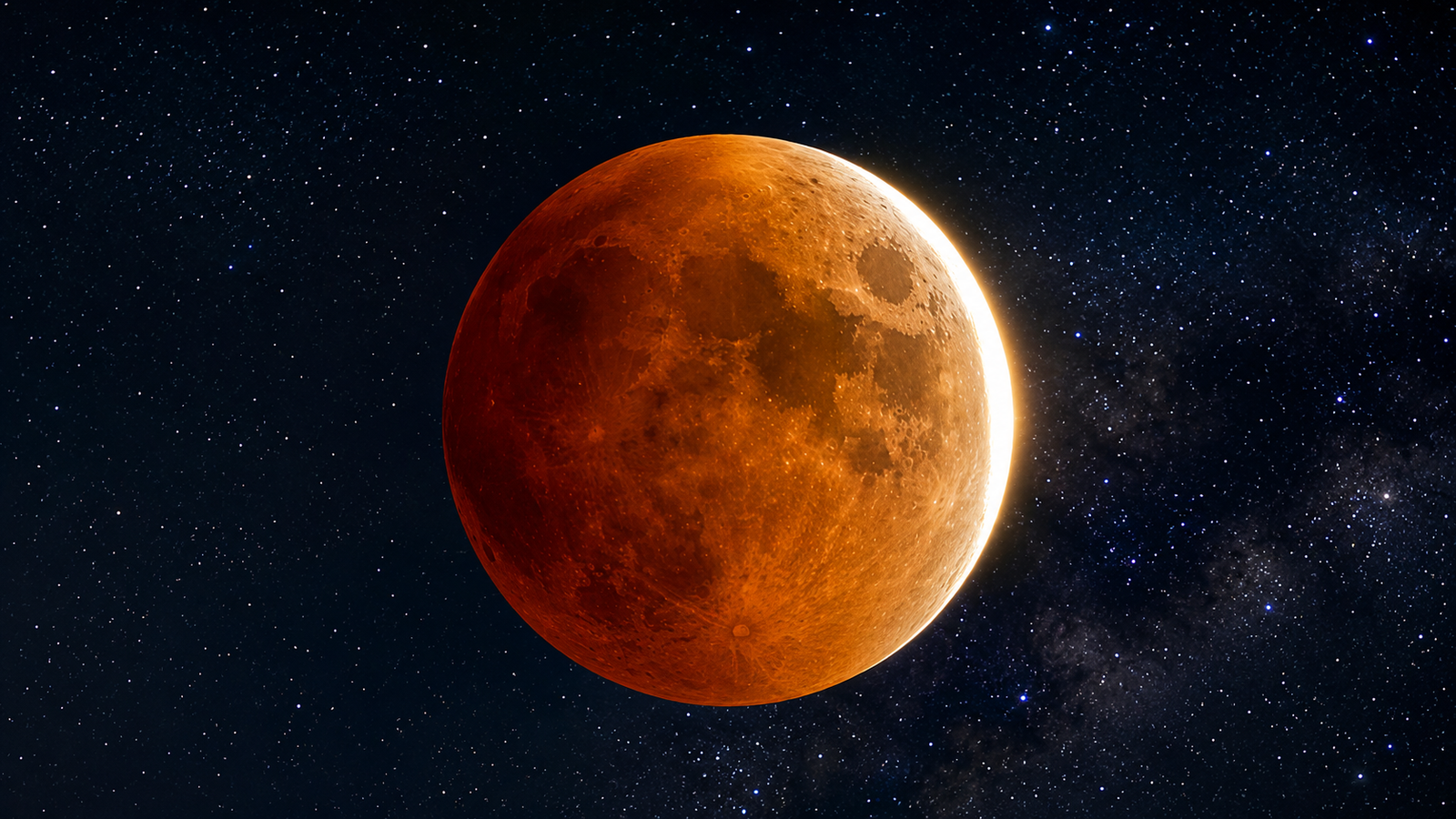
Stargazers and night-sky photographers across the globe witnessed one of the decade’s most striking celestial events as the Partial Lunar Eclipse of August 2026 swept across the full Sturgeon Moon.
Reaching a maximum umbral coverage of 96.2%, this ultra-deep partial eclipse turned the vast majority of the lunar disk into an “almost blood moon,” glowing in rich coppery-red tones while leaving just a razor-thin sliver of bright sunlight visible, as documented by astronomical trackers at Time and Date and international observatories.
August 27–28 Lunar Eclipse: Phase Timeline & Astronomical Data
Penumbral Start (9:23 PM EDT) ➔ Umbral Ingress (10:33 PM EDT) ➔ Maximum Eclipse 96.2% (12:12 AM EDT) ➔ Umbral Exit (1:51 AM EDT)
| Eclipse Dimension / Metric | Astronomical Data | Visual & Skywatching Dynamic |
| Maximum Umbral Magnitude | 96.2% Coverage | Deepest partial lunar eclipse visible until December 31, 2028 |
| Peak Alignment Time | 12:12 a.m. EDT (04:12 GMT) | Dramatic crimson and terracotta glow across lunar seas |
| Total Event Duration | 5 Hours, 38 Minutes | Over 3 hours spent within the dark central umbra |
| Associated Full Moon | Sturgeon Moon (August Full Moon) | Historically named after seasonal fish migrations |
| Visibility Footprint | Americas, Western Europe, Africa | Over 3.34 billion people within the broad viewing zone |
| Viewing Safety | 100% Naked-Eye Safe | No solar filters or specialized eye protection required |
4 Essential Insights from the Deep August Lunar Eclipse
1. The Science Behind the Deep Crimson Glow
Although not technically a total lunar eclipse (totality requires 100% immersion in the umbra), covering 96.2% of the lunar surface caused Rayleigh scattering to dominate the night sky. Sunlight passing through Earth’s dusty atmosphere had shorter blue wavelengths filtered out, projecting the collective glow of every sunrise and sunset on Earth onto the shadowed lunar highlands.
2. A Rare 1-in-a-Million Astronomical Opportunity
Astronomers confirmed that this was the deepest partial lunar event visible from Earth until late 2028. Observers in North and South America enjoyed prime viewing directly overhead, while skywatchers in Western Europe and Africa caught dramatic views as the coppery moon sank toward the western horizon before dawn.
3. Understanding Why Eclipses Arrive in Pairs
Lunar eclipses do not happen in isolation. They occur during “eclipse seasons” when the Moon’s tilted orbital plane aligns with the ecliptic. Whenever a deep lunar eclipse occurs during a full moon, it is typically preceded or followed two weeks later by a solar eclipse during the new moon phase.
4. Photographic Composite Milestones
From coastal bluffs in England to high-desert observatories in Arizona, amateur astronomers and astrophotographers captured stunning long-exposure composites. These detailed images showcased colossal craters like Tycho and Copernicus bathed in warm amber tones alongside Earth’s sharp curved shadow silhouette.
For readers tracking significant global science events, explore our recent report on high-altitude atmospheric weather patterns and space monitoring, or review official eclipse forecasting schedules via the NASA Eclipse Web
Read – Trump Renames Lake Ontario Lake America: 4 Big Reasons Behind the US-Canada Tariff Clash.