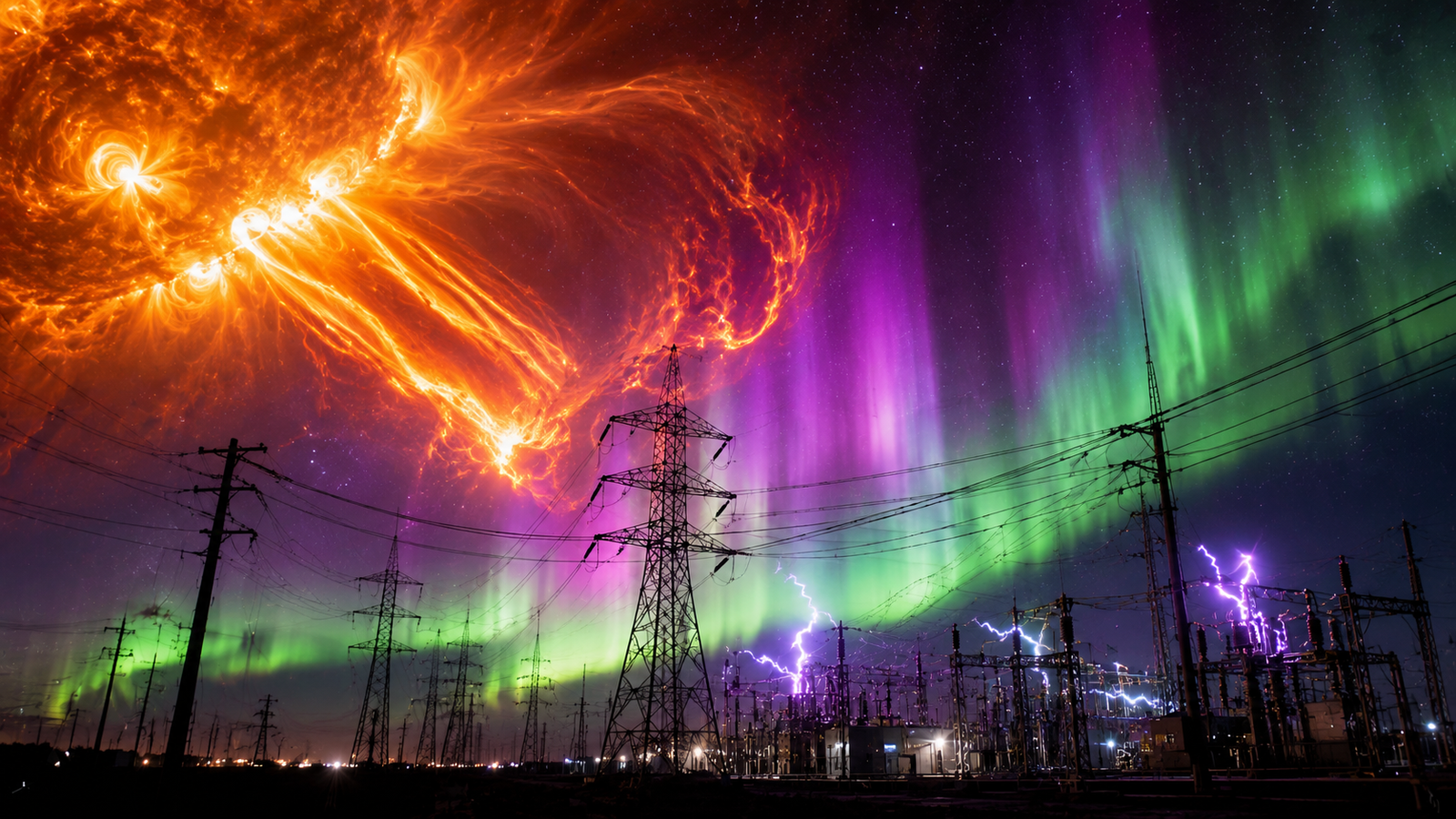
Could a violent explosion on the sun knock out electricity for millions of Americans and trigger a daily economic loss of $2 billion?
A groundbreaking scientific study published in AGU Advances reveals that a modern Carrington-scale geomagnetic storm would push major segments of the US power grid past their physical breaking points.
Solar Storm Hazard Matrix: Projected US Impacts
Solar Flare / CME Ejection ➔ Ground-Induced Currents ➔ Transformer Overload ➔ Cascading Voltage Collapse ➔ Regional Blackouts
| Storm Severity Category | Historical Benchmark | Affected Population | At-Risk Businesses | Estimated Economic Loss (Per Day) |
| 100-Year Event | Stronger than 1989 Quebec Event | 3.5 Million | 91,000 | $1.22 Billion |
| 150-Year Event | 1859 Carrington Event Equivalent | 4.2 Million | 110,000 | $1.50 Billion |
| 200-Year Event | Super-Geomagnetic Disturbance | 4.7 Million | 122,000 | $1.60 Billion |
| 250-Year Event | Extreme Worst-Case Space Weather | 5.1 Million | 135,000 | $1.81 Billion – $2.0 Billion |
Why the US Power Grid Is Vulnerable to Space Weather
When the sun expels superheated plasma during a coronal mass ejection (CME), charged particles slam directly into Earth’s magnetosphere.
This compression induces powerful electric currents into the ground, known as geomagnetically induced currents (GICs).
These ground currents travel through high-voltage transmission lines and enter heavy-duty transformers, causing severe voltage instability, overheating core components, and forcing safety switches to trip whole power corridors offline.
High-Risk Danger Zones: Where the Lights Go Out First
The latest research, led by Dr. Edward Oughton at George Mason University, highlights that geography and local geology determine which neighborhoods go dark first:
- The Northeast Corridor: Highly populated states face severe threats because local bedrock is extremely dense and resistive. Ground currents cannot bleed harmlessly into the Earth’s core, forcing them into transmission cables.
- The Northern Plains: High-latitude states sit directly under the entry points where solar particles penetrate the atmosphere near the magnetic poles.
- Interconnected Cascading Failures: The Eastern Interconnection links dozens of states together. A tripped substation in Maine can cascade unstable voltage signals down toward Washington, DC within seconds.
Economic Fallout: The $2 Billion Daily Price Tag
A catastrophic solar event disrupts far more than residential lightbulbs. Modern civilization runs on real-time synchronized data networks and consistent electric current.
- Manufacturing ($538M/Day): Automated assembly lines, semiconductor fabrication plants, and chemical processing facilities halt immediately during unexpected blackouts.
- Finance & Real Estate ($338M/Day): Digital transaction switches, ATM networks, and electronic trading desks freeze when localized backup generators fail.
- Agriculture & GPS Sensors ($64M/Day): As seen during the May 2024 solar storm, GPS signal degradation stalls precision farming tractors, delaying nationwide planting cycles.
Why This News Matters & What Happens Next
This research shatters the apocalyptic myth that a solar storm will send society back to the Stone Age for a decade, but it highlights urgent infrastructure vulnerabilities.
Modern grid reliability organizations (like NERC) have established 24-hour reboot protocols, yet thousands of high-voltage transformers across North America are over 40 years old.
Without targeted federal investments to install neutral ground-blocking devices and expand space-weather satellite early-warning networks from 6 hours to 24 hours, millions of households remain vulnerable to sudden blackouts during peak solar cycle peaks.
Key Highlights: 5-Point Quick Summary
- New Scientific Threat Model: An AGU Advances study maps the precise vulnerability of 16,000+ US transmission lines to extreme solar weather.
- Economic Toll: A 250-year solar storm could drain up to $2 billion daily from the American economy.
- 5.1 Million at Risk: Over 5 million residents and 135,000 businesses face multi-day outages during an extreme geomagnetic disturbance.
- Geological Hotspots: The Northeast and Northern Plains face the highest grid failure risk due to resistive bedrock.
- Early Warning Race: Forecasters at NOAA’s Space Weather Prediction Center are pushing to expand grid alert windows to 24 hours.
Frequently Asked Questions (FAQ)
What is a geomagnetic solar storm?
A geomagnetic solar storm occurs when massive clouds of solar plasma and magnetic radiation from the sun collide with Earth’s magnetic shield, creating induced electric currents on the ground.
Can a solar storm destroy the entire power grid permanently?
No. Modern power grids have automatic circuit breakers that trip to protect transformers from permanent meltdown, meaning most outages would last hours to days rather than years.
Which areas are at the highest risk of power loss?
The US Northeast and Northern Plains face the greatest risk due to high geographical latitude and hard bedrock that forces electrical currents into utility power lines.
What Do You Think?
Is the electrical grid prepared to handle the next historic solar storm, or does critical infrastructure need faster upgrades?
Share your thoughts in the comments below! If you found this breakdown informative, please share this article across your social media feeds.