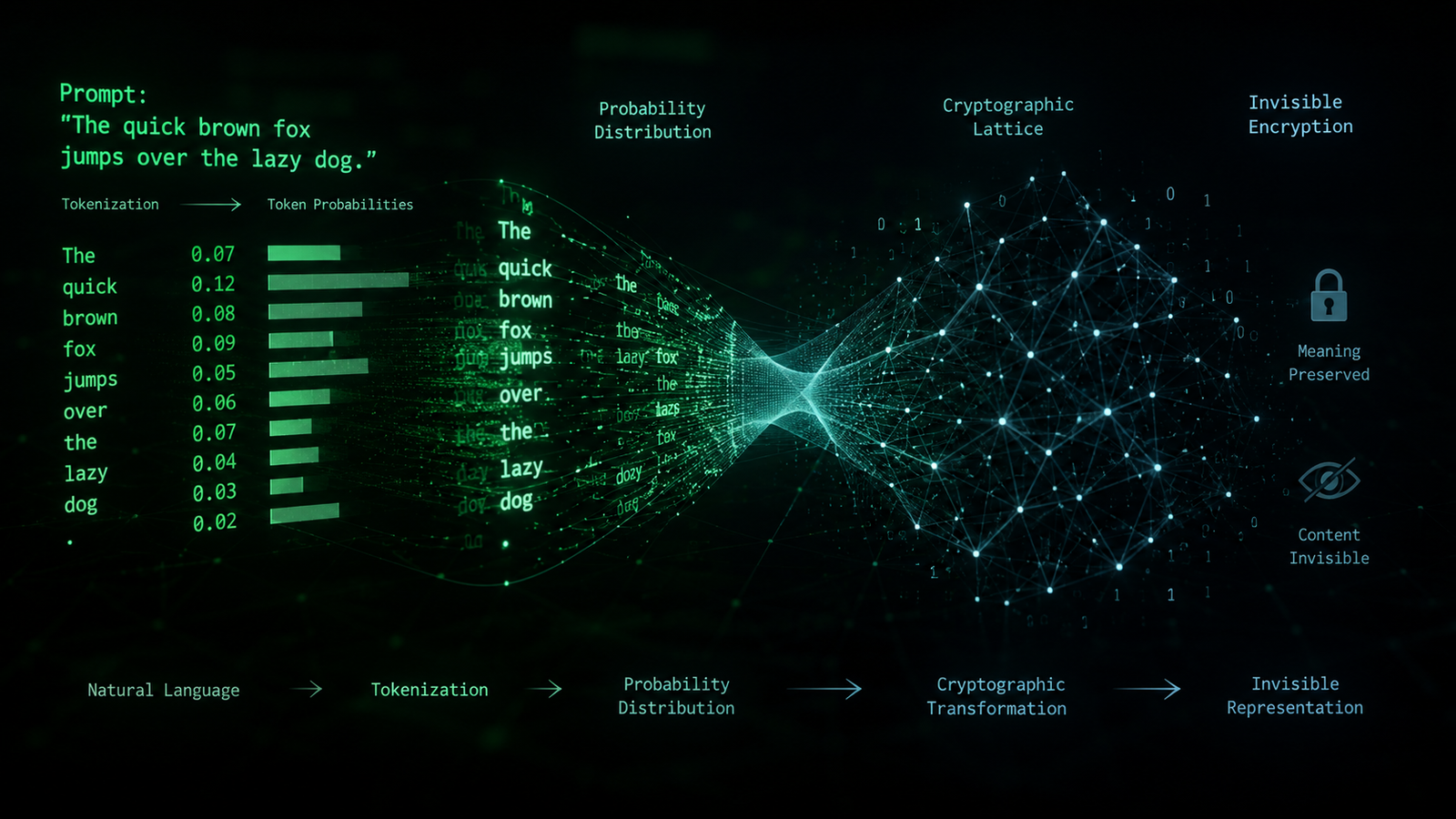
To comply with transparency mandates under the European Union’s AI Act (Article 50), AI research lab Anthropic has deployed an invisible text watermarking system across Claude.
Rather than embedding hidden Unicode characters, zero-width spaces, or container metadata, Claude uses an adaptation of Google DeepMind’s open-source SynthID-Text architecture. The system introduces statistical patterns into token selection without altering text quality, output speed, or generation costs.
How SynthID-Text Operates: The “Low-Stakes” Token Choice
Prompt Context ➔ Candidate Token Distribution (Logits) ➔ Secret Key Biases Random Choice ➔ Statistical Watermark Embedded
Large Language Models (LLMs) generate responses one word (or token) at a time by calculating probability distributions for the next sensible word. When multiple words carry nearly identical meaning and likelihood, the model typically resolves the choice using an arbitrary random number generator.
SynthID-Text replaces pure randomness with a cryptographically seeded pseudo-random function:
| Generation Step | Standard LLM (Un-Watermarked) | Claude with SynthID-Text Watermarking |
| Example Sentence | “The weather today was cold and…” | “The weather today was cold and…” |
| Top Candidates | overcast (48%), grey (47%), sugary (0.01%) | overcast (48%), grey (47%), sugary (0.01%) |
| Selection Method | Arbitrary pseudo-random draw | Deterministic selection driven by a Secret Cryptographic Key |
| Human Readability | Natural human English | Completely indistinguishable from un-watermarked text |
| Detection Mechanism | Heuristic perplexity guessing (high error rate) | Mathematical hypothesis testing using Anthropic’s private key |
Key Characteristics and System Boundaries
Anthropic’s technical release clarifies several core parameters regarding how the watermarking behaves in production:
- Zero Impact on Readability & Latency: The system does not force unnatural vocabulary or awkward phrasing. It only biases choices when multiple words are equally fitting.
- No User-Identifiable Telemetry: The watermark encodes model provenance (i.e., “This was generated by Claude”), not user account IDs, enterprise tenant details, or conversational transcripts.
- Behavior in Low-Entropy Outputs (Code & Math): Code snippets and mathematical derivations have far fewer valid word choices than natural prose. As a result, code output contains significantly less watermarking density than essays or summaries.
- Resilience to Copy-Pasting: Because the pattern is embedded in the word sequences themselves, copying and pasting plain text preserves the statistical signature. However, heavy manual rewriting dilutes the statistical certainty.
Regulatory Context: The European Union AI Act
The global rollout ensures Anthropic complies with the EU AI Act Code of Practice on Transparency of AI-Generated Content, which took effect in mid-2026 alongside signatories including OpenAI, Google, Meta, and Microsoft.
While Anthropic plans to provide a verification API for authorized institutions to decode watermarks, the company emphasized that watermarking confirms involvement rather than ownership—meaning it cannot distinguish whether Claude wrote an entire essay or merely proofread human text.